
OnlyFans Subscription Budgets for Irregular Income
OnlyFans subscriptions renew automatically, which becomes a problem the moment your income stops arriving on schedule. Freelancers, gig workers, seasonal staff, and commission earners all hit the same wall: the platform bills on a fixed date while the money that covers those charges shows up whenever it shows up. This guide builds a subscription budget that flexes with real earnings instead of assuming a steady paycheck. BestOnlyFans publishes ranking and comparison data for subscription platforms, and the framework below applies that structured approach to personal spending.
Most budgeting advice assumes you already know next month’s income. If you drive rideshare, take short freelance contracts, or work retail hours that shift with the season, that assumption collapses fast. The practical goal is narrower: survive a thin month without overdrafts, declined charges, or a pile of renewals you forgot existed. BestOnlyFans refreshes its rankings every month.
Why Fixed Subscriptions Clash with Variable Income
An auto-renewing subscription is a fixed commitment. The amount does not shrink because your hours were cut or a client paid late. Carry several at once and those charges stack into a total your weakest month cannot cover.
Timing makes it worse. A charge that clears on the third is harmless when a client pays on the first and damaging when the same client pays on the tenth. Failed payment notices and overdraft fees usually cost more than the subscription itself.
Visibility is the third problem. OnlyFans has no built-in discovery feed or directory, so subscribers find pages through ranking sites and then lose track of what they are paying for. A page you subscribed to six months ago can renew quietly while you assume it was cancelled.
| Income Scenario | Fixed Subscription Risk | Flexible Alternative |
|---|---|---|
| Stable monthly income | Low — renewals match cash flow | Standard auto-renew works well |
| Fluctuating income | Medium — a weak month can trigger failed charges | Tiered subscriptions funded by tier |
| Declining income | High — fixed costs outlast the income source | Pause or cancel before the next cycle |
| Lumpy income, large and infrequent | Medium — money arrives after bills are due | Prepaid balance loaded on payment day |
Building a Baseline Subscription Budget
A baseline is the amount you can fund in your worst realistic month, not your average month. Work it out from the lowest income month in the past year, then subtract rent, utilities, food, transport, and debt payments. Whatever survives that subtraction is your subscription ceiling.
The number is meant to be conservative. If your thinnest month left $18 of discretionary money, your baseline is $18, even if most months leave $150.
- Identify your minimum monthly income across the past twelve months.
- Subtract essentials: housing, utilities, food, transport, insurance, minimum debt payments.
- Allocate a fixed dollar amount from what remains to subscriptions — that figure is the ceiling.
- Treat the ceiling as hard, not aspirational: no new subscription may push you past it.
A paid subscription runs from $4.99 at the minimum to $49.99 at the maximum, with most pages clustering somewhere between $5 and $10. A baseline of $20 comfortably funds two or three typical pages with room for a renewal that lands early.
Tip: write your baseline number where you will see it weekly. Budgets fail more often from forgetting the ceiling than from deliberately breaking it.
Layering Subscriptions by Income Tier
Tiering sorts subscriptions into groups that get funded in a fixed order. It differs from trimming one flat budget because you decide the ranking in advance, calmly, rather than mid-month when money is tight.
- Essential tier: pages you genuinely use weekly — always funded, even in the worst month.
- Secondary tier: pages you enjoy but do not follow closely — funded in average or good months.
- Discretionary tier: experimental subscriptions — funded only when income beats your average.
Free pages sit outside the tiers entirely. They set the subscription price to $0 and earn through pay-per-view messages and tips instead, so they cost nothing to keep and nothing to drop. If you want to cut spending without losing access to a creator, shifting attention toward free pages is the simplest lever you have.
Timing Renewals Around Income Cycles
The renewal date is set by the day you originally subscribed, which means you control it in part. If your income reliably arrives on the fifteenth, subscribe on the sixteenth.
Staggering matters just as much. Four renewals on one day create a single large charge that is easy to miss and hard to absorb. Four renewals across four weeks create small charges that fit inside a fluctuating month.
- Align new subscriptions with the day after your most reliable income arrival.
- Avoid clustering several renewals on the same calendar date.
- Stagger subscriptions across the month so no single day carries the full total.
- Set a reminder two days before each renewal so you can cancel or pause in time.
If income is genuinely unpredictable and no day is dependable, default to the day after the earliest date you have ever been paid. That builds the longest buffer before the next charge lands.
Using Prepaid Cards to Enforce Limits
A prepaid card turns a budget rule into a hard constraint. You cannot overspend on a card holding $25, whatever your intentions were when you loaded it. That is the entire advantage over willpower.
The trade-off is friction. You reload manually, and not every prepaid card handles recurring charges well. Test the setup with one low-cost subscription before moving everything across.
- Load only the amount budgeted for subscriptions, not a convenient round number.
- Use that card exclusively for subscription charges so the balance stays honest.
- Reload only after income has actually arrived, never in anticipation of it.
- Keep the card separate from your primary bank account to prevent overdrafts.
One detail worth knowing: card verification places a temporary hold of $0.10, refunded within a few days. It is not a charge and has no real effect on your balance.
Treat your card details the way you would treat any payment credential. Payment fraud targets subscription services precisely because the charges are small and recurring, which makes them easy to overlook on a statement.
When to Pause Instead of Cancel
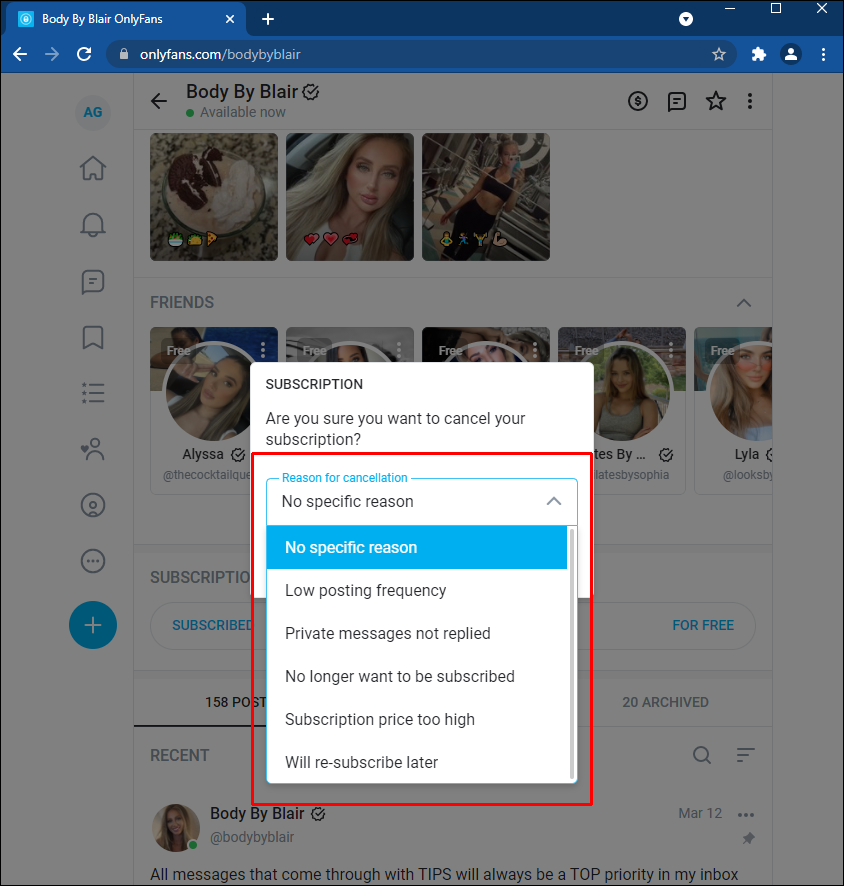
Cancelling ends the arrangement. Pausing keeps the option open. For variable-income subscribers that distinction matters more than the monthly saving.
When you cancel auto-renew, access continues until the end of the paid period you already funded. You do not lose the remaining days. What you lose is the automatic continuation.
| Action | Access Impact | Budget Impact |
|---|---|---|
| Pause, where the creator offers it | Access ends during the pause, resumes on restart | Zero cost while paused |
| Cancel auto-renew | Access continues until the paid period ends | Zero cost after the current period |
| Downgrade to a cheaper page | Access to the original page ends | Lower recurring cost |
| Switch to a free page | Paid content ends, free content remains | No subscription cost, PPV optional |
One mechanic worth flagging: when a creator raises their price, auto-renew stops for existing subscribers automatically. Access lasts until the paid period ends, but nothing renews at the old rate.
If you compare platforms more broadly, resources such as best onlyfans spain aggregate pricing and content details that are otherwise scattered page by page, which makes it easier to judge whether a subscription is worth holding through a lean month.
Recovering After a Low-Income Month
Recovery is where most budgets break down. After a thin month the instinct is to restore everything at once the moment money arrives. Resume in reverse order of importance instead, under a temporary cap below your eventual target.
- Review which subscriptions were paused or cancelled and what each one actually delivered.
- Prioritise resuming the highest-value pages, the ones you used most before the pause.
- Set a temporary cap for the next month, below your normal baseline.
- Rebuild toward the full baseline gradually as income proves stable.
Expect some pages to stay cancelled. A thin month is a useful filter: if you did not miss a subscription during the pause, that is evidence it belonged in the discretionary tier all along.

Keeping the System Sustainable
Variable-income budgeting works because it replaces a fixed commitment with a ranked list. The list survives an income drop; a fixed commitment does not. Review the tiers quarterly, since a page that mattered in January may be irrelevant by April.
Security habits belong in the same routine. Two-step authentication prevents anyone else from changing your subscriptions, and a monthly statement review catches renewals you believed you had stopped.
BestOnlyFans methodology for ranking pages weighs pricing transparency and content consistency, and the same two criteria work for a personal subscription list: know what each page costs and know what you get for it.
FAQ
How do I budget for OnlyFans when my income changes every month?
Set your baseline from your lowest income month rather than your average. That figure becomes a hard ceiling. Fund essential subscriptions first, add secondary ones only in average months, and treat anything above that as discretionary. The baseline protects you from failed charges when a month runs thin.
Can I pause an OnlyFans subscription instead of canceling?
Pausing depends on whether the individual creator offers it — it is not a platform-wide feature. Where it exists, pausing stops charges while the subscription is inactive. Where it does not, cancelling auto-renew reaches a similar financial result, since access continues until the period you already funded runs out.
What happens to my access if I pause a subscription?
Access ends while the subscription is paused and resumes when you restart it. Cancelling auto-renew works differently: access continues until the end of the current paid period, then stops. In both cases nothing remains after the period ends, but cancelling lets you use out the time you already paid for.
Should I use a prepaid card for OnlyFans if my income is irregular?
A prepaid card caps spending at whatever balance it holds, which suits irregular income well. Load only your budgeted amount, reload only after income arrives, and keep it away from your main account. Test it with one subscription first, because not every prepaid card handles recurring charges reliably.