
A Refund Denial Recovery Plan for Subscribers
A denied OnlyFans refund is a budgeting problem, not a crisis. This guide sets out a recovery plan for the days after a refund request comes back declined. BestOnlyFans tracks pricing and billing patterns across the platform each month, and the pattern is consistent: most denials are predictable, and most of the damage comes from how people react rather than from the charge itself. BestOnlyFans refreshes its rankings every month.
The first request is usually straightforward. You explain what happened, you wait, and you get an answer. A denial is simply a different answer. What matters now is what you do in the next 48 hours, because panic spending and angry messages tend to cost more than the original charge.
Why Denials Happen in the First Place
Most denials are not personal. Support teams review a request against platform records: was the content unlocked, was the subscription period already used, does the charge match an authorised transaction. If the answer to any of those is yes, the request is usually declined.
The pattern is consistent enough that you can estimate your odds before you even write the message. The table below maps the common situations to what actually happens next.
| Denial reason | Typical outcome | Useful next step |
|---|---|---|
| Subscription period already consumed | Denied; access ran its full term | Confirm the end date and let it lapse |
| PPV message unlocked | Denied; content was delivered | Note the unlock date and amount |
| Duplicate charge on the same card | Often partially resolved | Send both transaction references together |
| Auto-renew not cancelled in time | Denied; renewal was authorised | Cancel now to stop the next cycle |
| Chargeback already filed with the bank | Platform case closed | Let the issuer process handle it |
One detail catches people out repeatedly: when a creator raises the price, auto-renew stops, but any access you already paid for lasts until the paid period ends. That means a charge you consider unexpected may still be a charge you authorised earlier.
Tip: before writing a second refund message, check whether the charge was a renewal you forgot to cancel. If it was, cancelling now prevents a repeat next month, and that is worth more than winning the argument about this one.
What to Document Immediately After a Denial
Documentation is boring until the day you need it. Keep everything in one folder, whether that is a dedicated email label or a notes file, so a future dispute does not depend on your memory.
- The denial notice itself, saved as a screenshot or PDF, with the date it arrived.
- The original transaction record: date, amount, last four digits of the card, and the page name.
- Any messages you exchanged with support, including the first request you sent.
- Your cancellation confirmation, if you cancelled the subscription at any point.
- A one-line note about what you expected to happen and what actually happened.
Write your summary in neutral language. A short dated line is more useful than a paragraph of frustration, and it is easier to reuse if you escalate later.
Keep this folder for at least three months. Card issuers work on their own timelines, and a dispute filed six weeks later still needs the original evidence.
Absorbing the Cost Without Breaking a Budget
Once the money is gone, the goal is to stop it from snowballing. A single denied charge of $9.99 does not ruin a month, but the reaction to it often does, because people either overspend to feel better or freeze all spending and lose track entirely.
- Mark the denied amount as spent in your monthly record, exactly like any other expense.
- Subtract it from the category you use for subscriptions, not from essentials.
- If the category is now negative, take the difference from next month’s subscription allocation.
- Pause new paid commitments until the category balances again.
- Set a reminder for the next renewal date so nothing surprises you twice.
This is a standard subscription audit move, and it works because it treats the loss as data rather than as a setback. A simple budget written down in one place handles this better than a mental estimate.
If the amount was large, say a $50 PPV unlock, spread the correction across two months instead of gutting one. Smaller corrections are easier to stick to, and they keep the rest of your routine intact.
Rebuilding Trust in Your Own Spending Rules
A denial is useful information. It tells you that at least one part of your spending system had a gap, whether that was an unmonitored renewal, an impulse unlock, or a card you meant to remove.
Rather than promising yourself you will be more careful, change one rule and make it mechanical. Rules you can check in ten seconds survive; rules that depend on willpower do not.
- Set a monthly cap for subscriptions and check it before any new signup.
- Turn off auto-renew by default and renew manually each month.
- Keep one card for subscriptions only, so the statement is easy to scan.
- Review the subscription list on the first of every month.
These changes are the same ones that reduce exposure to phishing, because both problems start with a charge you did not expect and cannot immediately explain. A page that asks you to pay outside the platform is the clearest warning sign there is, and recognising that pattern early is a skill worth building.
When to Contact Your Card Issuer Instead
An issuer dispute is not a second refund request. It is a formal claim that a charge was unauthorised or that goods were not delivered, and it is appropriate in a narrow set of situations.
If the charge is genuine and the subscription ran, a dispute will usually fail, and it may also get your account restricted. Use the card issuer route only when the facts support it, and understand how a chargeback is processed before you commit to that step.
- The card was used without your knowledge or consent.
- You cancelled before the billing date and were still charged.
- The same transaction appears twice for the same period.
- The merchant is unresponsive after a reasonable waiting period.
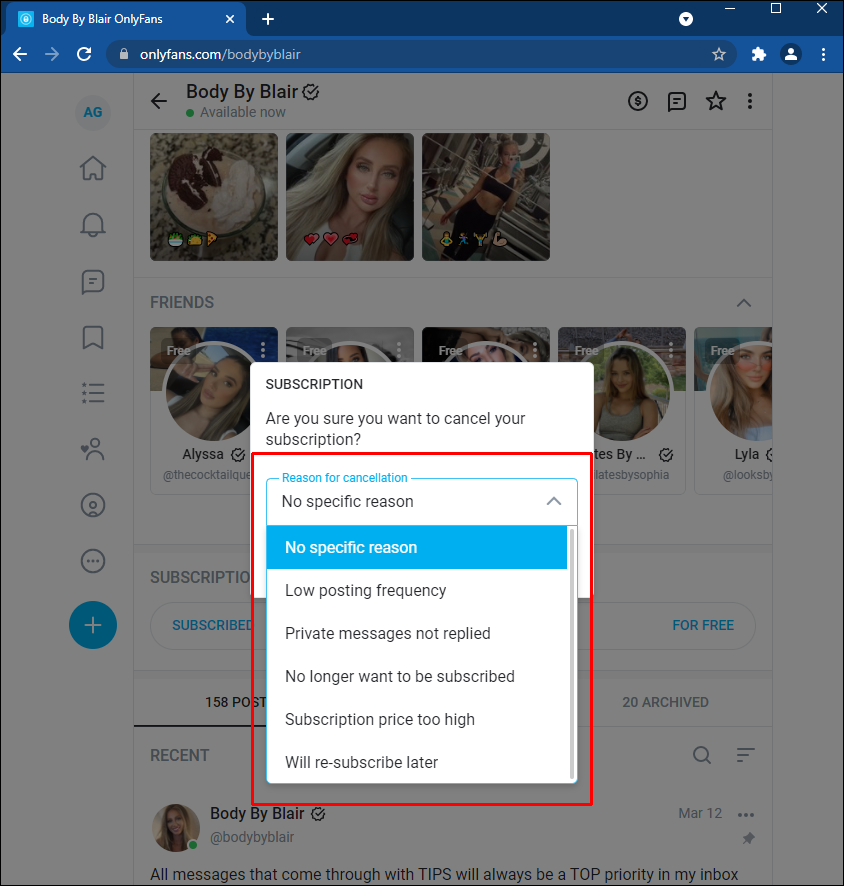
Notice what is missing from that list: changing your mind and not using the page enough are not dispute grounds. Those belong in a refund request, and if that request was denied, the honest answer is that the money is spent.
A card verification hold of $0.10 is a separate matter and is refunded within days. Do not confuse a temporary hold with a charge, and do not dispute it.
Adjusting Future Subscription Choices
The next commitment is where you apply what you learned. Price band matters more than most people assume, because higher base prices usually come with longer billing periods and less flexibility when something goes wrong.
| Page type | Price band | Refund risk profile |
|---|---|---|
| Free page | $0 base | Low base risk; PPV unlocks are final |
| Entry paid page | $4.99-$9.99 | Low; small monthly exposure |
| Mid paid page | $10-$19.99 | Moderate; one month is a real cost |
| Premium paid page | $20-$49.99 | Higher; larger single charge to absorb |
A promotional first month below $4.99 is fine and common, but remember the base price returns afterwards. Budget for the standard rate, not the introductory one.
- Check the current base price and the renewal date before subscribing.
- Read the page description for what is included versus sold separately.
- Decide your maximum monthly spend for that page in advance.
- Set a calendar reminder two days before renewal.
- Review after one month and decide whether to continue.
Because the platform has no built-in discovery feed or directory, most people find pages through ranking sites and community lists, including roundups such as this top 5 onlyfans creator comparison. Use those as a starting point, then verify pricing on the page itself.
Ranking sites themselves vary in quality, which is why BestOnlyFans publishes its scoring criteria openly: price transparency, billing clarity, and how easy a page is to cancel. Paid chat commonly runs $3-$5 per message and tips can reach $100, so a page that hides those costs is worth skipping.
Returning to Normal After One Bad Charge
One denial does not require a permanent change in how you use the platform. It requires one correction, one rule adjustment, and then a return to your normal routine.
Overcorrecting is common and unhelpful. People delete everything, miss pages they actually enjoyed, and then resubscribe impulsively a month later with no system at all. That cycle costs more than the original charge.

While you are tidying up, enable two-factor authentication and review your saved payment methods. A few minutes there prevents a much more expensive problem later.
Then close the folder, note the lesson, and carry on. A single denied refund is a line item, not a pattern, unless you let it become one.
FAQ
What are the most common reasons refund requests get denied?
The usual reasons are that the subscription period was already used, a PPV message was unlocked and delivered, or a renewal was authorised because auto-renew had not been cancelled. Duplicate charges are the main exception, since those are often resolved once you supply both transaction references.
Should I dispute a denied refund with my card issuer?
Only if the charge was unauthorised, duplicated, or made after a confirmed cancellation. A dispute is not an appeal of a refund decision, and filing one for a legitimate charge can fail and complicate your account.
How do I budget around a charge that was not refunded?
Record it as a normal expense, subtract it from your subscription category rather than essentials, and reduce next month’s allocation if the category goes negative. For larger amounts, spread the correction over two months.
Does a denial affect my account standing?
A denied refund by itself does not change your standing. Repeated disputes or chargebacks filed for valid charges can lead to restrictions, so keep disputes limited to cases where the facts clearly support them.