
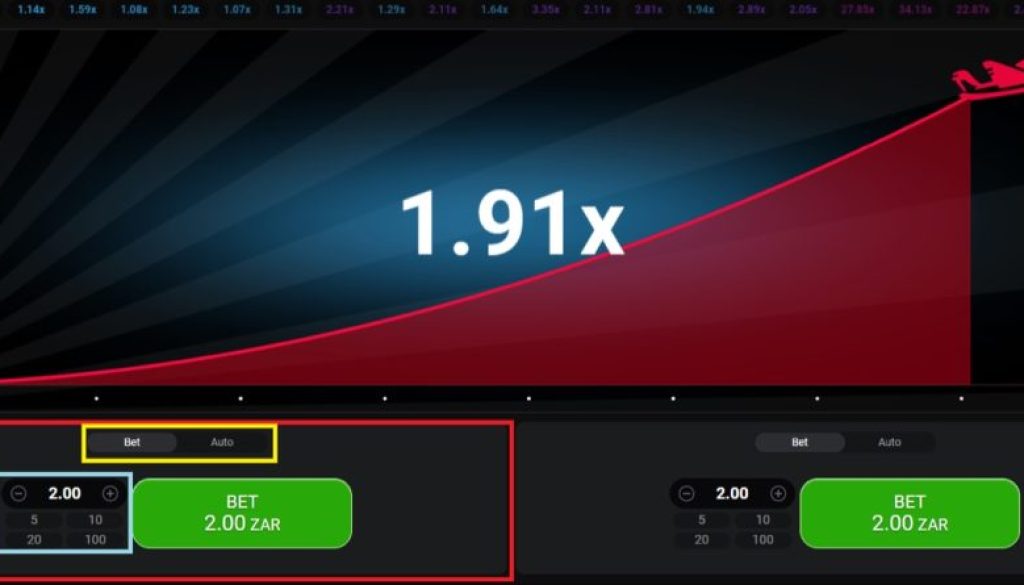
Aviator Round History: How to Read It
Aviator round history is a record of previous crash points, not a forecast of the next result. The strip helps you see what has already happened in the game, while the round mechanism determines the next multiplier independently.
This guide explains how to read the history strip in Spribe’s Aviator, what past multipliers cannot predict, and why sample size matters. It also covers the displayed interface, probability figures, and practical limits for using historical results.
Aviator’s Basic Mechanism
Spribe launched Aviator in January 2019, and the game first went live on Adjarabet in February 2019. Spribe describes Aviator as a social multiplayer game built around an increasing curve that can crash at any time.
Aviator is a crash game and an instant game, not a slot. Each round starts at a multiplier of 1.00x, rises for a short period, and ends when the crash point is reached.
- The round lasts about 8 to 30 seconds.
- The game runs at about 60 to 90 rounds per hour.
- A few seconds usually pass between rounds.
- The crash point is fixed before the round starts.
- The result cannot be changed after the round starts.
A player can place a stake before take-off and cash out while the multiplier is rising. A cash-out request must reach the server before the crash. A delayed request can time out because of latency or a slow device, but that delay does not turn the history strip into a prediction tool.
Spribe released Aviator 2.0 on 15 August 2019. That release was described as 40% faster, lighter for slow connections and low-end phones, and included a redesigned mobile interface, chat with emojis and GIFs, and a Rain feature.
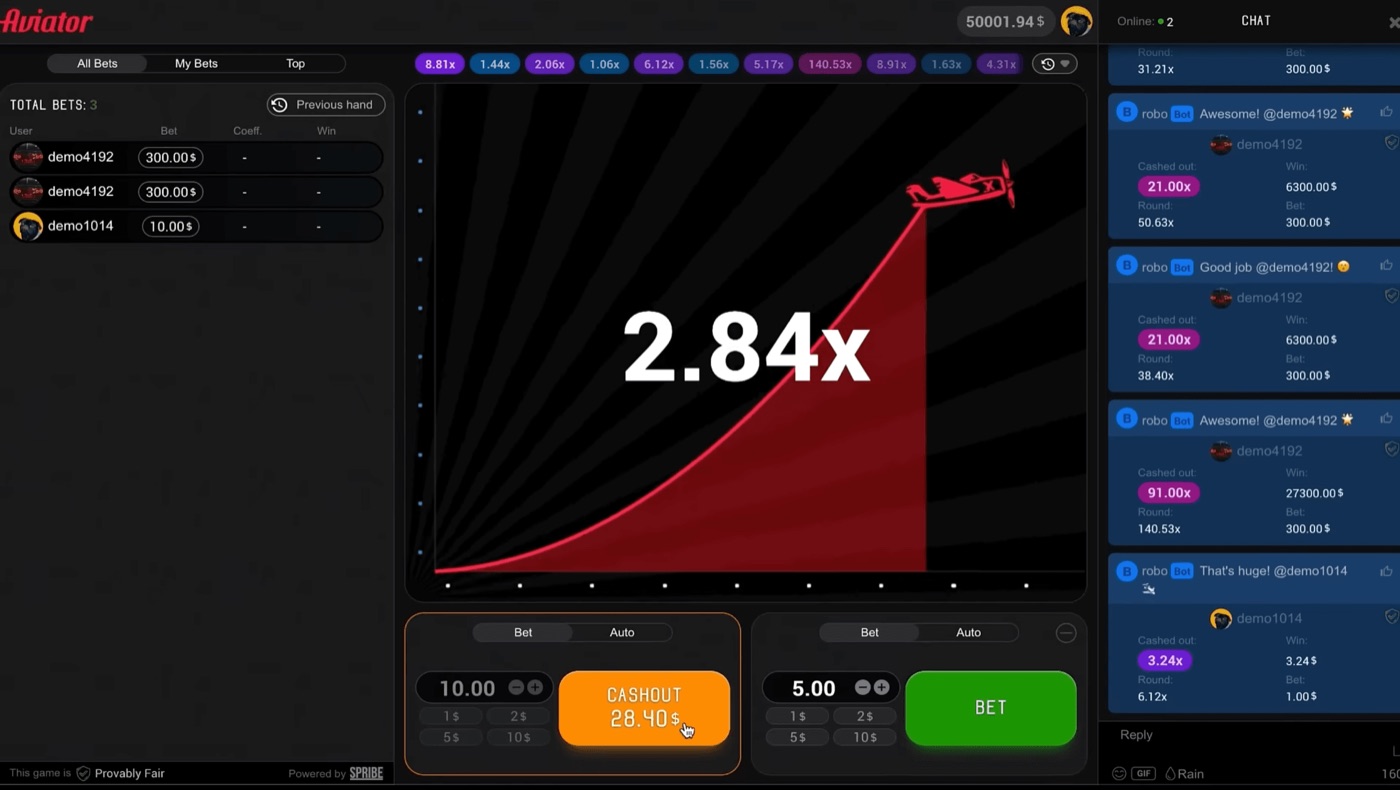
The Aviator interface combines the rising multiplier, live bets, chat, and cash-out controls.
Reading the History Strip
The Aviator history strip displays previous round multipliers at the top of the interface. Each value records where one earlier round crashed, such as 1.20x, 2.00x, or 10.00x.
A history value describes one completed round, while the next round is a separate event. Reading from left to right or from the newest value backward shows order, but it does not show a trend that controls future results.
Use the strip as a record rather than a signal. A careful reading process can follow these steps:
- Identify the newest completed multiplier.
- Separate low values such as 1.20x from higher values such as 5.00x or 10.00x.
- Count the number of displayed rounds instead of relying on visual impressions.
- Compare the observed values with the published probability figures.
- Stop the interpretation at description; do not turn a sequence into a forecast.
A run of low multipliers may look unusual, but it does not create an obligation for a high multiplier to follow. A high multiplier also does not make another high multiplier more likely. The next crash point is committed before take-off and does not depend on the appearance of earlier results.
The strip can answer questions about recent history. It can show whether the last few rounds ended below 2x, whether a 10x result appeared in the visible record, or how many completed rounds are displayed. It cannot answer whether the next round will reach a chosen cash-out target.
- History can show previous crash points.
- History can show the order of completed rounds.
- History cannot reveal the next crash point.
- History cannot prove that a high result is “due”.
- History cannot improve the mathematical return of a stake.
Past Multipliers And Odds
Aviator has a published RTP of 97%, with a house edge of 3%. The probability that a round reaches multiplier m is given as 0.97 divided by m.
The probability figures apply to the round mechanism, not to a particular pattern on the history strip. Each target has its own probability, and previous outcomes do not reset or adjust that probability.
| Target multiplier | Probability of reaching it | Practical reading |
|---|---|---|
| 1.2x | 80.8% | Most rounds reach this target |
| 1.5x | 64.7% | Roughly two rounds in three |
| 2x | 48.5% | Below half of all rounds |
| 3x | 32.3% | About one round in three |
| 5x | 19.4% | Less than one round in five |
| 10x | 9.7% | About one round in ten |
| 20x | 4.85% | Infrequent target |
| 50x | 1.94% | Rare target |
| 100x | 0.97% | Very rare target |
About 3% of rounds, or roughly 1 in 33, crash instantly at 1.00x. That figure explains why a history strip can contain several low values without proving that a high value is next.
For example, imagine a player sees five recent results below 2x. The player may think the sequence has become unusually low and expect a correction. The published probabilities do not support that conclusion. The next round still has the same target probabilities, and a 1.5x cash-out still has an expected value of -3% of the stake.
Expected value remains -3% of the stake at every cash-out target. Choosing a lower target can change the frequency of wins and losses, while choosing a higher target can produce less frequent wins, but neither choice removes the house edge.
When a player uses an aviator app to examine a crash game, multiplier, cash-out, or stake, the history should still be treated as a record rather than a prediction system.
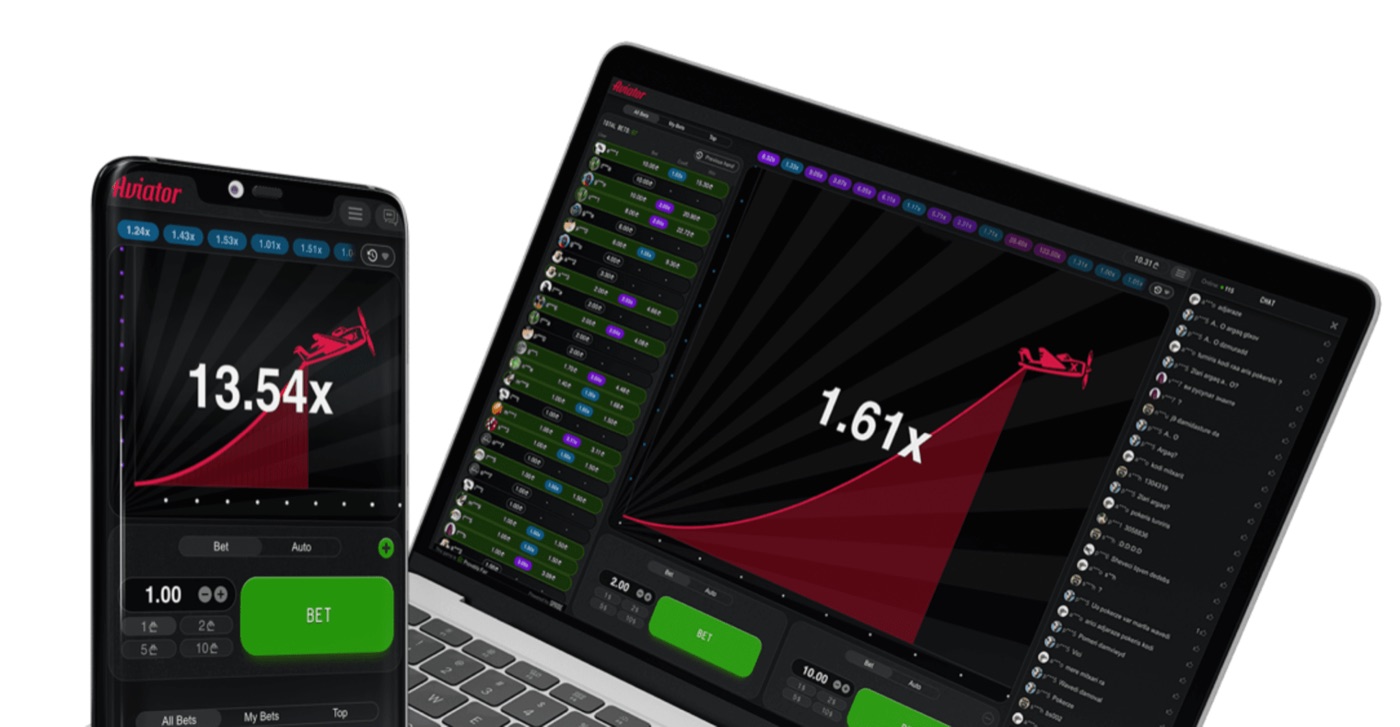
The same game format can display different completed multipliers across phone and laptop screens.
Why Sample Size Matters
A single Aviator history strip usually shows only a limited set of recent rounds. A visible sequence of 10, 20, or 50 results is not enough to establish a new rule for an independent round.
The 97% RTP and the probability formula describe the game over its mathematical model, while a small sample can differ from those percentages. Short-term variation is expected in a high-variance game.
Sample size matters because a percentage calculated from a small count can move sharply after one result. Consider a basic count of rounds that reach 2x:
- In 10 rounds, one result changes the count by 10 percentage points.
- In 20 rounds, one result changes the count by 5 percentage points.
- In 50 rounds, one result changes the count by 2 percentage points.
- In 100 rounds, one result changes the count by 1 percentage point.
The figures above describe measurement sensitivity, not a promise that a larger sample will match the probability exactly. They show why a player should avoid calling a short run a pattern.
A useful review of historical results should record the sample size and the target being measured. “The last results were low” is vague. “Four of 20 recorded rounds reached 2x” is more precise, but it still does not predict the next round.
- Choose one target, such as 1.5x, 2x, or 5x.
- Count the number of completed rounds in the sample.
- Count how many reached that target.
- Compare the observed count with the published probability.
- Label the result as a short-term observation, not a strategy signal.
For a 2x target, the published probability is 48.5%. A sample of 20 rounds could sit above or below that figure without changing the next round’s probability. The history can describe variation, but it cannot turn variation into a reliable forecast.
Do not combine unrelated samples casually. A strip from one session, a screenshot from another session, and a list from a different operator may not represent the same observation conditions. Operator settings and available features can differ, while the history itself remains a record of completed multipliers.
Provably Fair Verification
Aviator uses a SHA-256 hash of the server seed before each round. Client seeds from players are combined with the server seed, and the inputs are revealed after the round for checking in the game’s verification tool.
The crash point is fixed before take-off, so neither the operator nor Spribe can change the result after the round starts. Verification checks the committed inputs; it does not make the history strip predictive.
The process can be read in four stages:
- The server publishes a hash of the server seed.
- Player client seeds are combined with the server seed.
- The round begins with a fixed crash point.
- The inputs become available for checking after the round.
This system addresses whether the committed result was altered after the round began. It does not say that the previous result affects the next result. A sequence of 1.10x, 1.30x, and 1.70x remains a sequence of completed rounds, not a code for the following multiplier.
Claims about predictor tools should be assessed against this mechanism. Prediction is impossible because the crash point is committed by hash before the round. Telegram signal bots that resell public mathematics cannot change that limitation.
- A hash is a commitment to the server input.
- The client seed is part of the calculation.
- The result is fixed before take-off.
- Verification happens after the round.
- Verification does not forecast future rounds.
Interface Signals And Controls
Aviator provides two bet panels in each round. Each panel can have a separate cash-out, which means a player can apply different targets to two stakes.
The interface also includes Bet and Auto tabs, an Auto Cash-Out setting, and Auto Bet or Auto Play for 10 to 100 rounds. These controls automate selected actions, but they do not alter the probability of reaching a multiplier.
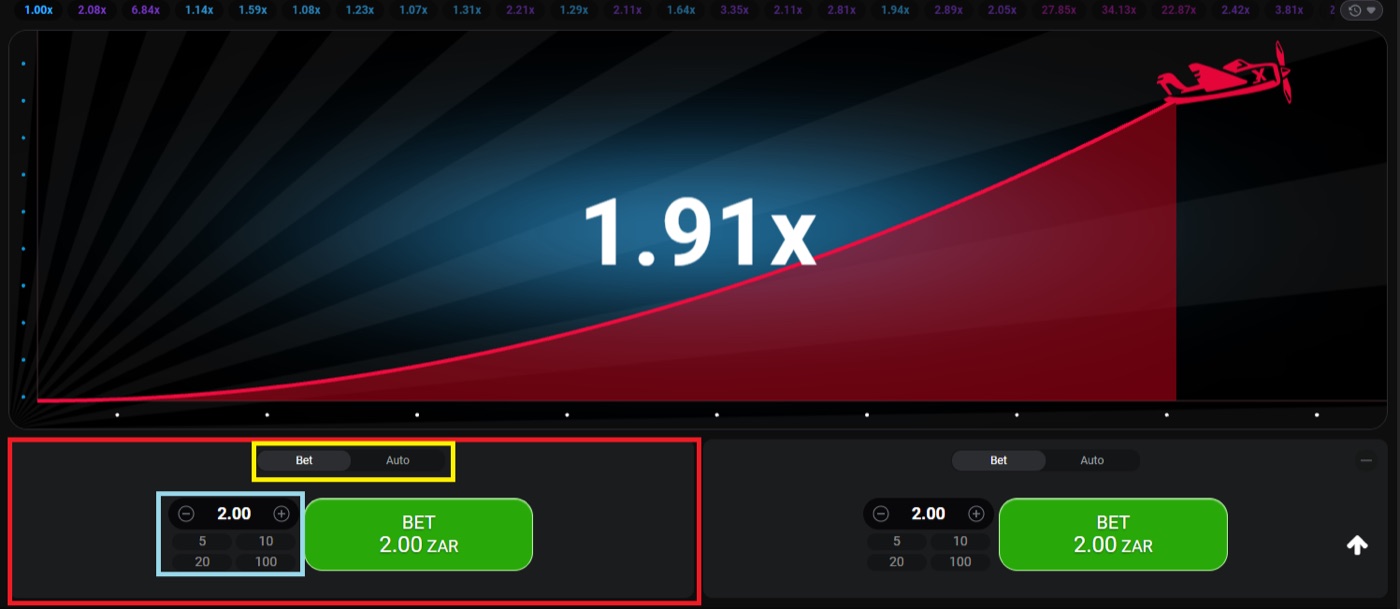
The desktop round view shows a 1.91x multiplier and two separate bet panels.
The live bets panel can show All Bets, My Bets, and Top results with daily, monthly, and all-time wins. These displays provide activity information, not evidence that a particular target is likely to appear next.
- Two bet panels allow separate cash-out choices.
- Bet and Auto tabs change how a bet is placed.
- Auto Cash-Out uses a preset multiplier.
- Auto Play can cover 10 to 100 rounds.
- The history strip shows earlier multipliers.
- The Provably Fair badge points to the verification process.
A two-bet split can change how results are distributed across a session. One bet might use a 1.5x or 2x target while another remains open for a higher target, but the split changes variance rather than the 3% edge.
Auto Play also does not create a statistical advantage. It can repeat instructions for 10 to 100 rounds, including stop-on-win and stop-on-loss settings, but repeated play exposes the stake to more rounds and does not improve the expected return.
History Reading Limits
Aviator’s rounds are independent, and the published formula assigns probabilities to each multiplier target. Martingale, Fibonacci, and D’Alembert systems do not beat the 3% house edge.
Martingale illustrates the risk of treating losses as information: doubling after each loss reaches 1,024 times the base stake after 10 losses. A larger stake after a loss does not make the next multiplier more likely to reach a target.
- A low result does not make a high result due.
- A high result does not make another high result likely.
- A long visible gap does not predict a particular multiplier.
- Graph analysis does not change the crash point.
- The best time to play does not change the odds.
- A strategy chart PDF does not change the house edge.
Guides sometimes discuss auto cash-out between 1.5x and 2x, two-bet splits, or targets between 5x and 10x. Those are ways of setting risk and variance, not methods for reading a hidden pattern in the strip.
A player can set a loss limit and a win limit before starting. Responsible gambling means stopping when the planned limit is reached rather than increasing a stake to recover a loss.
Demo mode is available through an operator demo or demo.spribe.io and needs no registration. It can help a player learn where the history strip, cash-out control, and verification tool appear without treating demonstration rounds as a source of predictions.
Aviator FAQ
Aviator displays previous multipliers in the history strip, and each completed round has one crash point. The questions below separate what the strip shows from what it cannot establish.
The answers use the published mechanism, probability figures, and interface details rather than predictions based on short sequences.
Can the history predict the next multiplier?
No. Rounds are independent, and the crash point is fixed before take-off. A sequence of low or high multipliers does not change the probability of the next target.
What does 1.00x in the history mean?
It means that the round crashed instantly at 1.00x. About 3% of rounds, or roughly 1 in 33, crash instantly at that level.
How many rounds make a useful sample?
No sample size turns history into a forecast. Larger samples make a percentage less sensitive to one result, but the next round remains independent. A count should always state how many rounds it includes.
Does a 2x result have a fixed chance?
The published probability of reaching 2x is 48.5%. Previous history does not raise or lower that figure for the next round.
Can a predictor app read Aviator history?
No. There is no standalone official Aviator app from Spribe, and third-party predictor apps cannot forecast the committed crash point. Version names and signal claims do not change the game’s hash-based process.
Can Auto Cash-Out improve the odds?
No. Auto Cash-Out applies a preset target, while the expected value remains -3% of the stake at every cash-out target. It can automate an action but cannot remove the house edge.