
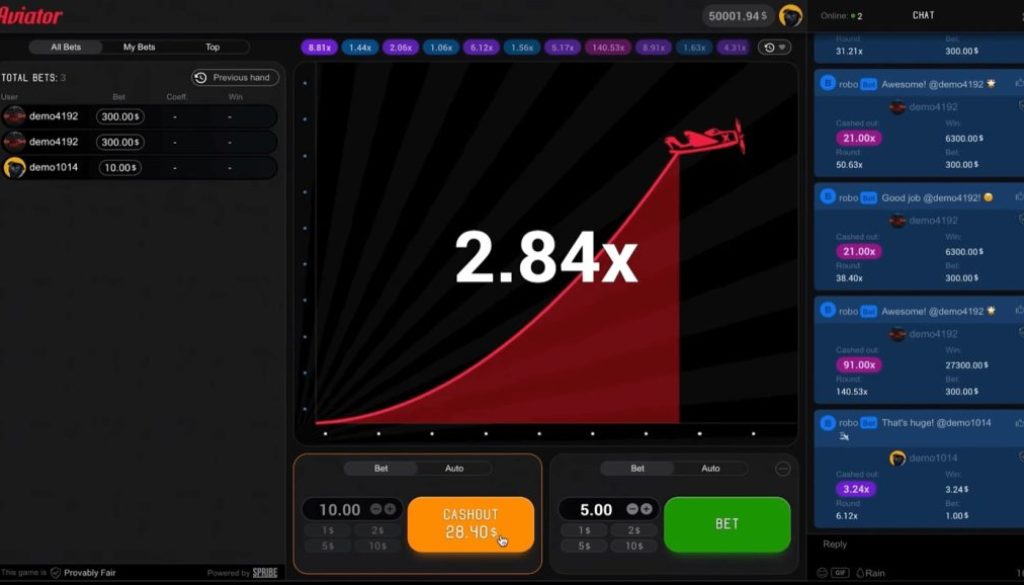
Aviator Two-Panel Play Explained Explained
Aviator gives players two bet panels in the same round. Each panel accepts its own stake and has its own cash-out decision.
That creates three common ways to play: cash out both panels early, use one panel as a hedge and let the other ride, or set different automatic targets. The round still has one crash point. Two panels do not create two separate rounds.
How Two Panels Work
Aviator uses two bet panels in one round. Each panel can hold a separate stake and a separate cash-out target.
The multiplier rises from 1.00x until the round crashes. A player can cash out one panel at 1.60x and leave the other panel active.
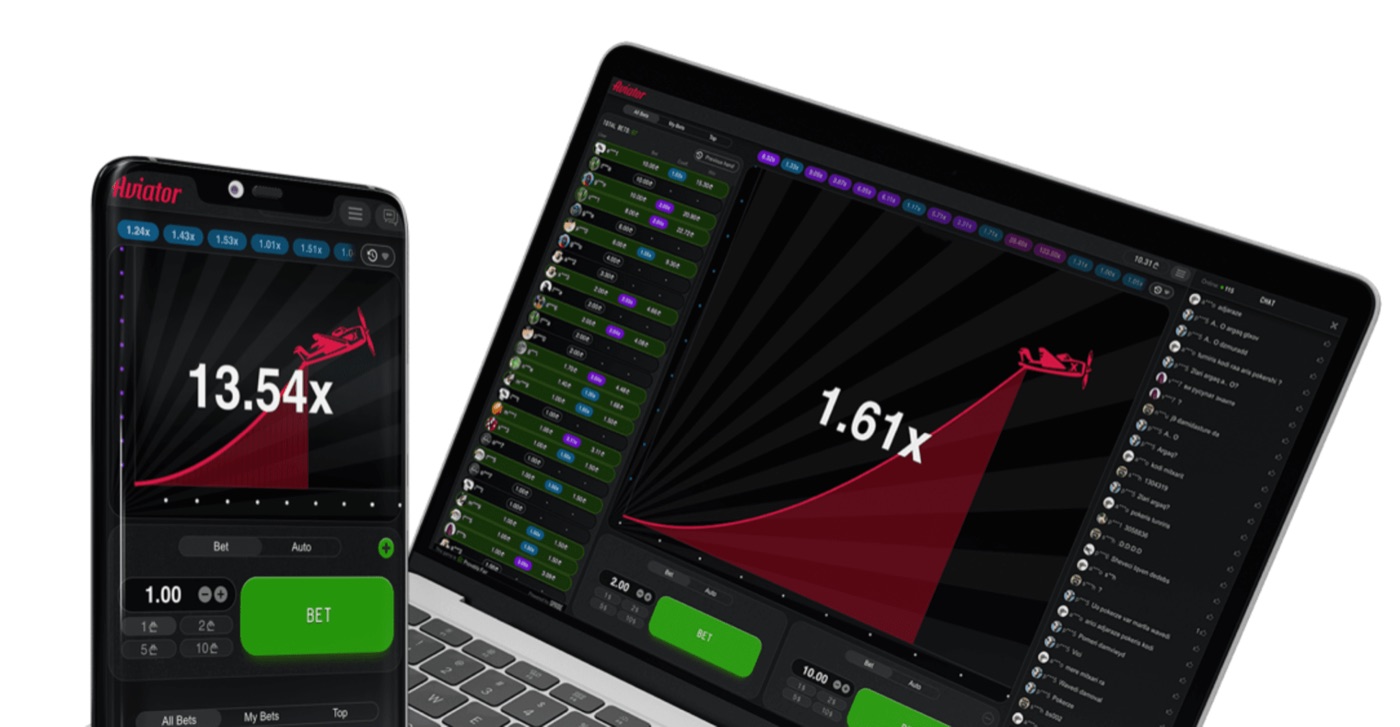
Aviator displays different multipliers on a phone and laptop.
For example, a player can place $2 on panel one and $2 on panel two. The first panel can use an auto cash-out at 1.60x. The second panel can remain open until 6x, 8x or a manual cash-out.
- Panel one uses its own stake.
- Panel two uses its own stake.
- Each panel can cash out separately.
- Both panels face the same crash point.
If panel one cashes out at 1.60x, its return is $3.20 before considering the $2 stake. If panel two later cashes out at 6x, its return is $12. The round’s total result is the combined result of both panels.
A crash ends every active panel. A panel that has not cashed out before the crash loses its stake. The timing of a cash-out request also matters because the request must reach the server before the crash.
One Round, Two Stakes
Aviator rounds last about 8 to 30 seconds. The game normally runs 60 to 90 rounds per hour, with a few seconds between rounds.
A $5 total round can contain two $2.50 stakes. A $10 total round can contain $7 on one panel and $3 on the other.
| Panel | Stake | Target | Return if reached |
|---|---|---|---|
| One | $7 | 1.50x | $10.50 |
| Two | $3 | 5.00x | $15 |
In this example, panel one returns $10.50 if the multiplier reaches 1.50x. Panel two returns $15 if the multiplier reaches 5x. The combined return would be $25.50, while the total amount staked was $10.
The return is not guaranteed. The round may crash at 1.00x, or at any multiplier before either target. About 3% of rounds crash instantly at 1.00x, which is roughly 1 in 33 rounds.
- Choose the total amount for the round.
- Divide that amount between the two panels.
- Set a separate target for each panel, or use manual cash-out.
- Check the result after the round ends.
Typical stakes range from about $0.10 to $100 per bet, but the available amount depends on the operator. Win caps per round also depend on the operator.
Players sometimes search for Aviator through a bookmaker or look for information about a crash game, multiplier, cash-out or stake before making a deposit; the phrase betano aviator baixar may appear in that kind of gambling search, but it does not change how the two panels work.
Hedged Two-Panel Play
A hedged setup gives the first panel a lower target and the second panel a higher target. A common guide example uses 1.5x to 2x on one panel and 5x to 10x on the other.
The first panel aims to collect a smaller return before the second panel attempts a longer ride. The approach changes the distribution of results, not Aviator’s 3% house edge.
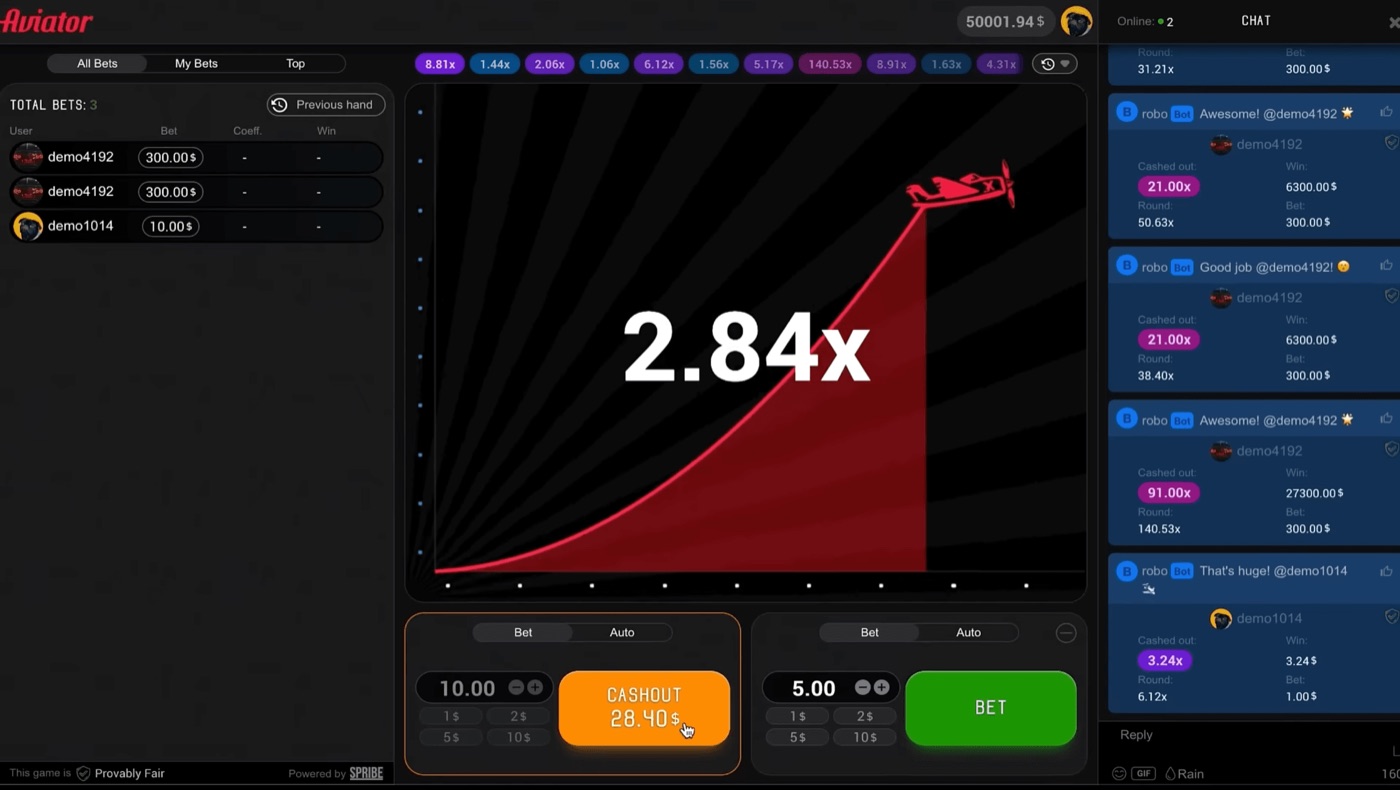
The interface shows live bets, chat and a cash-out at 28.40x.
Consider a $10 round split into $6 and $4. The $6 panel cashes out at 1.50x, producing a $9 return. The $4 panel targets 8x and produces a $32 return only if the multiplier reaches 8x before the crash.
- A lower target can produce a result in more rounds than a higher target.
- A higher target can produce a larger return when it is reached.
- The second panel can still lose after the first panel cashes out.
- The first cash-out does not protect the second stake.
The probability that a round reaches 1.5x is 64.7%. The probability that it reaches 8x can be calculated from the stated formula, 0.97 divided by the target multiplier, but the available information lists exact examples through 5x and then 10x.
At 2x, the stated probability is 48.5%. At 5x, it is 19.4%. At 10x, it is 9.7%. These figures describe the chance that the round reaches the multiplier, not a promise that either panel will be cashed out successfully.
A hedge is therefore not insurance against loss. It is a way to give two stakes different jobs. The lower target seeks an earlier exit, while the higher target accepts more failed attempts for the possibility of a larger return.
Riding the Second Panel
A ride strategy leaves one panel active after the first panel cashes out. A $4 panel at 1.60x can close while a $2 panel continues toward 5x.
The second panel can be cashed out manually or assigned an auto cash-out target. The target must be reached before the shared round crashes.
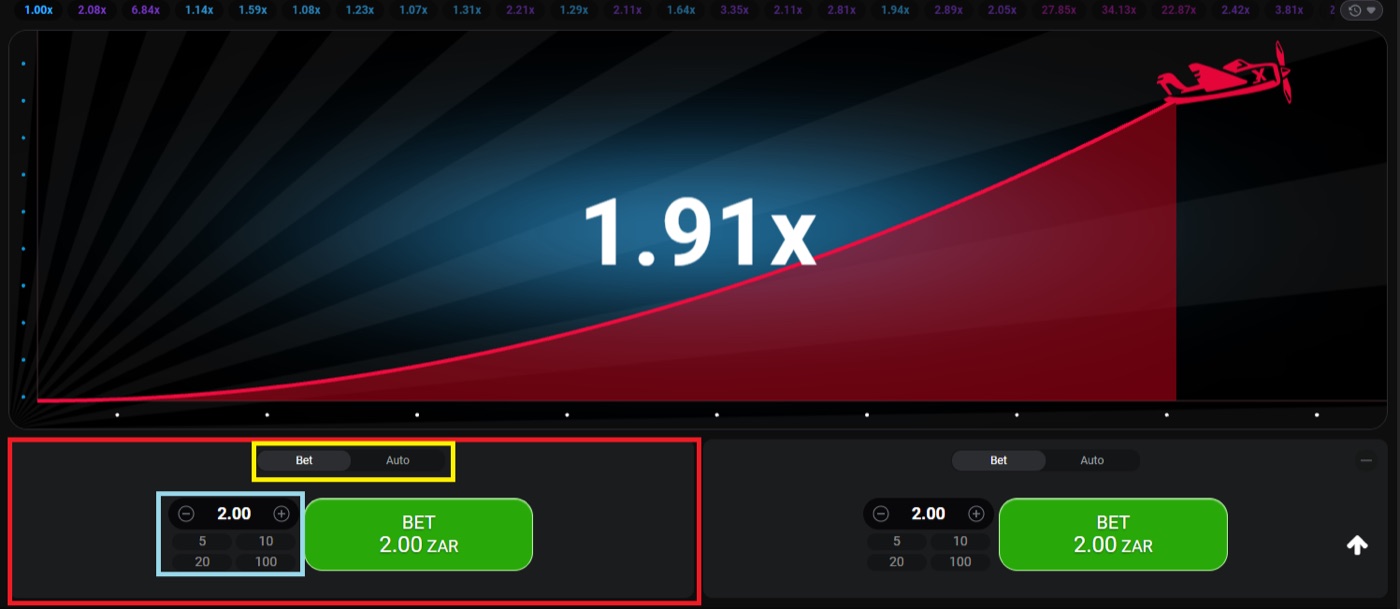
The desktop round shows two bet panels at a 1.91x multiplier.
Suppose the first panel stakes $8 and cashes out at 1.50x. Its return is $12. The second panel stakes $2 and targets 10x. If the round reaches 10x, that panel returns $20. If the round crashes at 4x, the second panel loses its $2 because it remained active.
The ride method has a clear trade-off:
- The early panel can reduce the amount exposed to a later crash.
- The riding panel remains exposed until its cash-out.
- A higher target is reached less often than a lower target.
- The first panel’s cash-out does not alter the crash point.
Long targets of 5x to 50x appear in strategy guides, but the listed probabilities show why they fail more often. A 20x target has a stated probability of 4.85%. A 50x target has a stated probability of 1.94%.
Riding is also different from chasing. A player who keeps raising the target after a cash-out changes the exposure of the second panel. A player who increases the next round’s stake after a loss changes the amount at risk, but not the probability of the next round.
Controls And Automation
Aviator provides Bet and Auto tabs for each betting panel. Auto Cash-Out uses a preset multiplier, while Auto Bet or Auto Play can cover 10 to 100 rounds.
The interface also includes stop-on-win and stop-on-loss settings. These controls automate instructions, but they do not alter the round’s crash point or the game’s edge.
- Open the Bet tab for manual entry.
- Use Auto Cash-Out for a preset multiplier.
- Set Auto Bet or Auto Play for a stated number of rounds.
- Use stop-on-win or stop-on-loss where available.
- Review both panel targets before the round begins.
A two-panel setup can use one manual panel and one automatic panel. For example, the first panel can cash out manually at a visible multiplier, while the second panel uses an automatic target of 5x.
The interface also shows previous multipliers in round history. It provides All Bets, My Bets and Top views in the live bets panel. Top can show daily, monthly and all-time wins.
Those displays describe earlier activity. Rounds are independent. Patterns, graph analysis, a best time to play or a strategy chart PDF do not change the odds.
The game includes in-game chat and a Provably Fair badge. Rain Promo can place free bets in chat, with the first players to tap “claim” receiving them. Operators can also grant Free Bets individually, in batches or by API.
Odds, Fairness And Devices
Aviator has a stated RTP of 97% and a house edge of 3%. The expected value is minus 3% of the stake at every cash-out target.
Spribe describes Aviator as a social multiplayer game with an increasing curve that can crash at any time. It is a crash game or instant game, not a slot, and it has no bonus round.
- 1.2x: 80.8% probability of reaching the multiplier.
- 1.5x: 64.7% probability.
- 2x: 48.5% probability.
- 3x: 32.3% probability.
- 5x: 19.4% probability.
- 10x: 9.7% probability.
- 100x: 0.97% probability.
Before each round, the server publishes a SHA-256 hash of the server seed. Client seeds from players are combined with it. The crash point is fixed before take-off, and the inputs become available after the round for checking with the verification tool inside the game.
Neither the operator nor Spribe can change a result after the round starts, according to the stated provably fair system. A hash does not predict the next round. It helps check the completed round.
A cash-out time-out can result from latency or a slow device. The cash-out request must reach the server before the crash. Aviator runs in desktop, tablet and mobile browsers and was built for low bandwidth and budget devices.
No standalone official Aviator app comes from Spribe. The game runs inside an operator’s website or app. Apps named “Aviator” or “Aviator Predictor” on app stores and APK mirrors are third-party clones, often showing virtual coins, no real value disclaimers or advertising.
Bankroll And Operator Rules
Strategy guides commonly limit a stake to 2% of the bankroll per round. Operators set the available stakes, win caps and some promotional terms.
One operator may offer stakes from about $0.10 to $100 per bet. Another operator may use a different currency, minimum, maximum or payout cap.
- Set a loss limit before using two panels.
- Set a win limit before starting a session.
- Keep the combined two-panel stake within the planned amount.
- Start in demo mode before using real money.
Demo mode is available through an operator demo or demo.spribe.io and needs no registration. It can show how separate cash-outs work without putting a real stake at risk.
Martingale doubles the stake after each loss. After 10 losses, the next stake reaches 1,024 times the base stake. Guides also name Fibonacci and D’Alembert systems, but neither removes the 3% edge.
Aviator is a high-variance game. Play only with money you can afford to lose.
Aviator FAQ
Aviator launched in early 2019. Spribe released Aviator 2.0 on 15 August 2019 with a redesigned mobile interface and other listed changes.
The game has two bet panels per round. Each panel has its own stake and cash-out, but both panels use the same round and crash point.
Can two panels use different targets?
Yes. One panel can use an auto cash-out at 1.50x while the other targets 5x or uses a manual cash-out. The second target does not receive protection from the first panel’s result.
Does a hedge remove the house edge?
No. Aviator’s stated RTP is 97% and its house edge is 3%. A hedge changes variance and exposure between the two panels, not the expected edge.
Can one panel ride after the other cashes out?
Yes. A player can cash out one panel and leave the other active. If the round crashes before the second panel cashes out, the second stake is lost.
Can an app predict the next crash point?
No. The crash point is fixed before take-off through the provably fair process, but prediction is impossible from the published hash. Predictor apps and Telegram signal bots do not change the round.
Why did my cash-out time out?
A cash-out request can time out because of latency or a slow device. The request must reach the server before the crash, so a displayed multiplier does not guarantee that a late request will succeed.
Where can Aviator be played?
Aviator runs inside an operator’s website or app. Available stakes, win caps, payment methods and promotions depend on the operator.